





Amazon Tightens Review Sharing Rules Across Product Variations
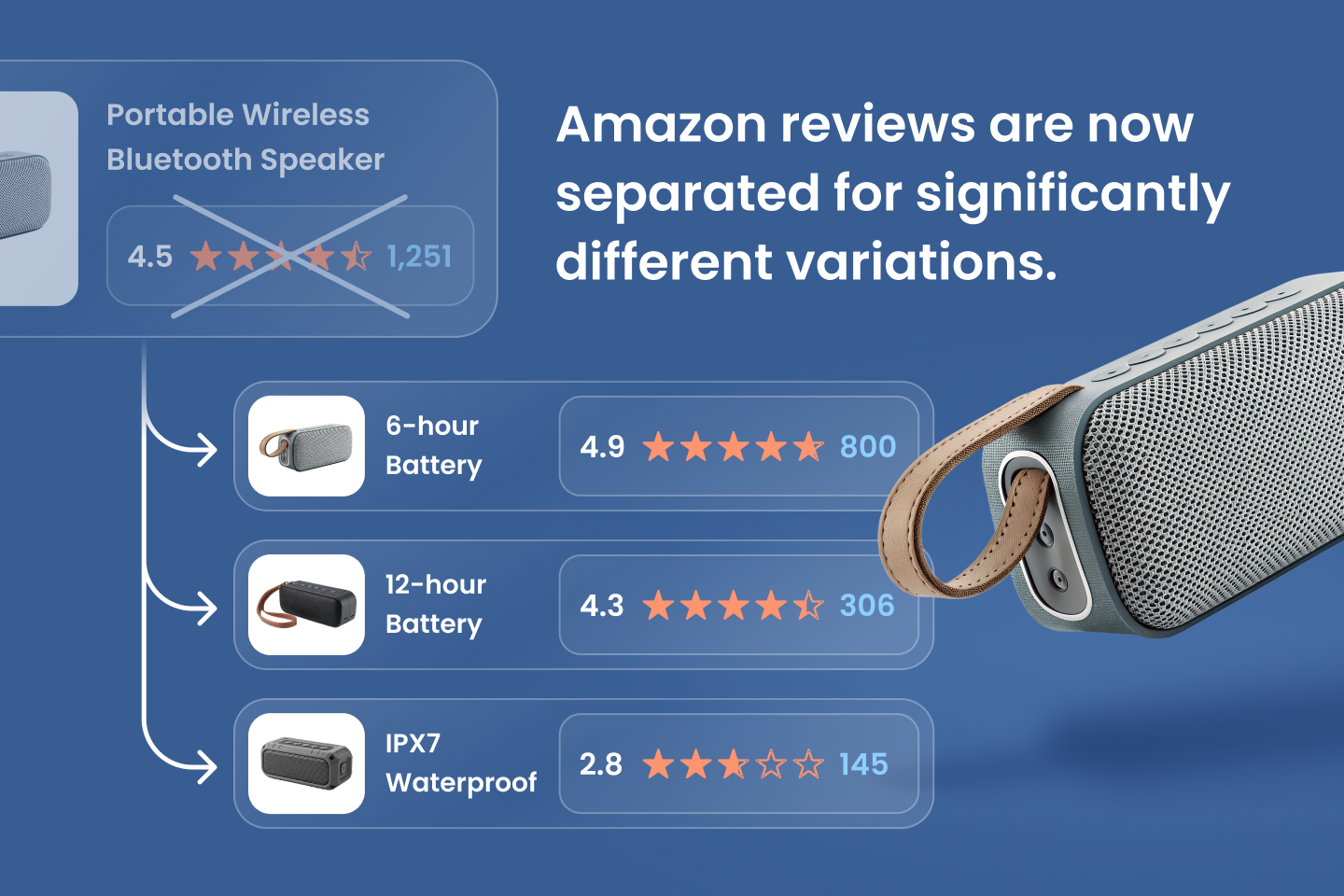
Review Sharing Rules Have Changed on Amazon
If you have ever toggled between different sizes, colors, or versions of a product on Amazon and noticed the same star rating and review count at the top, you have seen review sharing in action.
For years, Amazon has allowed reviews to be shared across different versions of the same product when they are grouped under one listing. A single rating could reflect feedback from multiple variations, even when those versions were not identical.
Now, Amazon is narrowing how that works.
In a recent announcement, the company said that when product variations differ in significant ways, such as features or specifications, shared reviews may not accurately represent the version that a customer is considering. A shopper could read strong reviews about one variation and purchase another that performs differently, which Amazon says can reduce confidence and potentially increase returns.
Starting February 12, 2026, Amazon will update how review sharing works. The rollout will happen gradually by category between February 12 and May 31, 2026. Sellers will receive an email notification 30 days before the update affects their products.
Under the new approach, reviews will only be shared across variations with minor differences that do not affect core functionality. When variations differ in ways that meaningfully impact performance or experience, reviews will no longer be pooled together. Amazon has stated that this may affect visible star ratings and review counts at the variation level.
Reviews are not being removed. They are being redistributed so that ratings more closely reflect the specific version a shopper is evaluating.
Where Reviews Will Continue to Be Shared
Amazon provided examples to clarify when review sharing remains in place.
When differences do not affect performance or intended use, reviews can continue to be shared.
A blue cotton T-shirt and a red cotton T-shirt will still share reviews because color does not change how the product performs. The same applies to a 3-tier ladder shelf and a 5-tier ladder shelf, since both serve the same function. A 250ml bottle of shampoo and a 500ml bottle of shampoo can continue sharing reviews because the formula and experience remain the same.
Amazon also includes lemon cleaning spray and lavender cleaning spray as an example, where scent is considered secondary and does not affect performance. Phone cases for different device models remain grouped as well, since they serve the same purpose despite differing fitment.
Where Reviews Will No Longer Be Shared
Review sharing stops when variations introduce meaningful differences in performance, capability, or customer experience.
Amazon’s examples include a gaming laptop with 16GB RAM and an Intel i5 processor versus one with 32GB RAM and an Intel i9. In that case, performance differences create distinct experiences. A 700W microwave versus a 1200W microwave will no longer share reviews because power output affects cooking performance. The same logic applies to a 20W Bluetooth speaker versus a 50W Bluetooth speaker, an external HDD versus an external SSD, and a Wi-Fi 5 router versus a Wi-Fi 6 router, where generation or underlying technology changes capability.
Outside of electronics, a camera body versus a camera body plus lens bundle is treated separately because bundles change value and usage. In consumables, chocolate protein versus vanilla protein and rose candles versus jasmine candles are split because flavor or scent directly shapes the experience. Variations such as slim fit jeans versus regular fit jeans, aluminum pans versus stainless steel pans, gold pendants with rubies versus gold pendants with sapphires, and golf clubs for beginners versus golf clubs for advanced players are also treated as distinct because fit, material, design, or intended user group changes how the product is experienced.
Across all of these examples, the distinction comes down to whether the difference between variations affects how the product performs or is used.
What This Means for Brands in Practical Terms
On Amazon, reviews are central to trust and conversion.
It is also important to remember that brands built listings based on the rules and marketplace norms that existed at the time. Many grouping decisions were made to simplify catalog management or create a smoother shopper experience, not to manipulate reviews.
If this update feels frustrating, that reaction is understandable.
In the short term, some listings may look different. Individual product versions that previously benefited from a shared review pool may show fewer reviews or slightly adjusted star ratings. That could influence how those variations convert or how advertising performs at the variation level.
At the same time, based strictly on Amazon’s announcement:
- Review sharing is not disappearing.
- It remains in place for variations with minor, non-functional differences.
- The rollout is gradual and includes advance notice.
- Sellers can review and adjust their variation structures.
Over time, the update places more emphasis on how accurately listings reflect real product differences. Where variations align cleanly with product reality, disruption may be limited. Where distinct products were grouped together, those versions will now stand independently.
What Brands Should Do Next
Amazon is guiding brands to review their variation structures and ensure they accurately reflect product differences.
Ask:
- Do these versions truly deliver the same customer experience?
- Are the differences cosmetic, quantity-based, or functional?
- Does the variation theme match the difference?
Amazon has also confirmed that if variation themes are corrected after the change takes effect, reviews can be re-shared for eligible products.
Yogi’s Take
Within Yogi, regardless of the data source, whether consumer care tickets or retailer site reviews, we have long separated meaningful product differences from simple attributes, aiming to preserve the maximum granularity available. Cosmetic or minor differences that do not redefine the product can roll up to a “parent SKU”. When a change affects performance, formulation, fit, or overall customer experience, it is treated as a distinct variant that can be filtered and analyzed independently.
That structure is intentional. It preserves data integrity and ensures consumer feedback maps accurately to the actual product experience brands are trying to understand.
For some teams, Amazon’s update may require revisiting variation structures that were built under previous marketplace norms. That will take adjustment. At the same time, the direction of the change reinforces a principle that benefits consumers: product differences should be reflected clearly in how feedback is organized and interpreted.
The connection between product structure and review signals is becoming tighter. Transitions like this can be disruptive, but improvements in clarity and consumer trust often create stronger foundations for brands over time.
Unified Intelligence, Finally Within Reach
Ask Yogi cuts through silos and transforms scattered feedback into one continuous thread of truth—accessible to every team, whenever they need it.
It’s fast, defensible, and finally, actionable.
If you’ve ever wished for a way to get to the “why” behind your data without the delay—it’s here.
For a limited time, book a demo—and ask Yogi anything.

.png)
