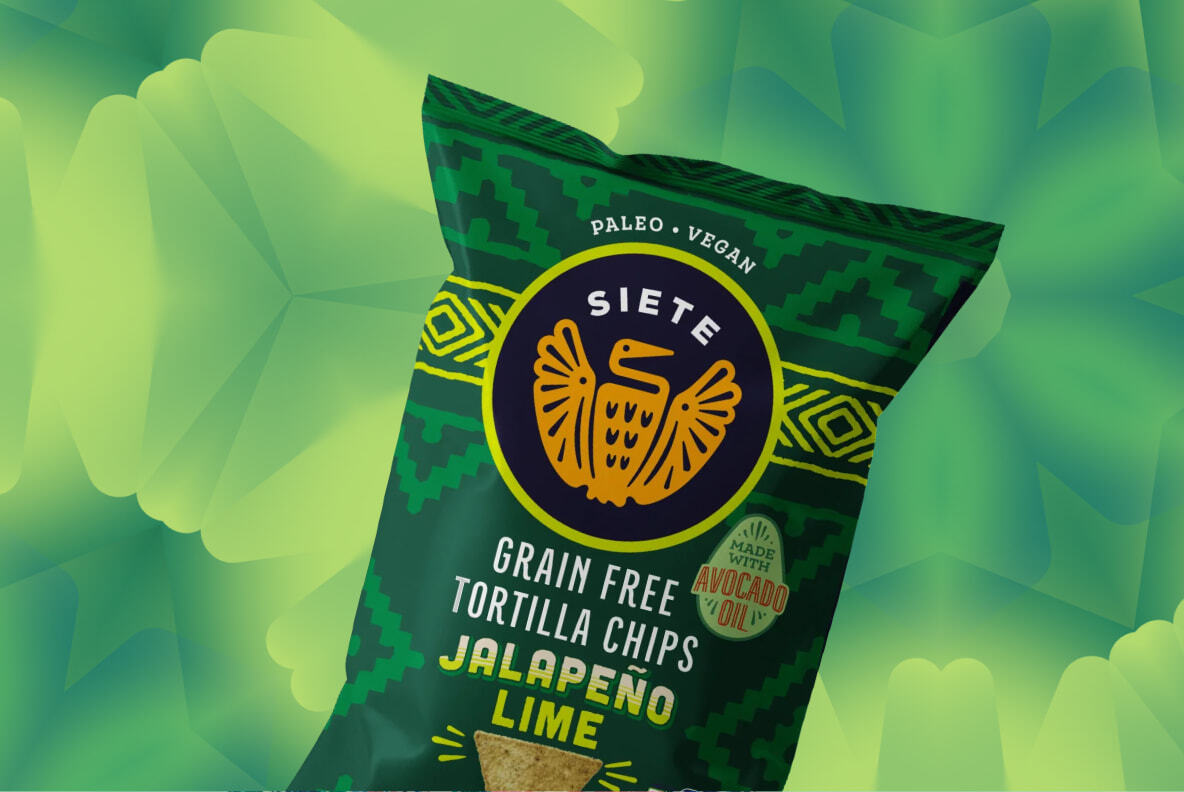
Siete Foods grew household penetration fivefold while thousands of consumer messages arrived every week. Yogi gave every team the same view of that feedback, so intuition could be checked against evidence instead of one opinion.
One truth, not one opinion
A sentiment question used to route through two or three people on the customer delight team and end in a judgment call. Now it resolves against the full body of consumer feedback.
Intuition still leads, data validates
The sourdough tortilla came out of a culinary sprint, not a trend report. Feedback on texture and resilience confirmed a direction the team already liked rather than choosing it for them.
Ask twice, get the same answer
Feedback is organized against Siete's real product catalog, down to category and SKU. A question about tortillas or potato chips returns a consistent answer, which is what makes it defensible.
About
Siete Foods
Siete Foods makes grain-free tortillas, chips, sauces, and snacks rooted in Mexican-American family recipes. Founded by the Garza family after one member adopted a grain-free diet, the brand now sells nationally and is part of PepsiCo.
There is a question that gets asked at every consumer brand, usually in the middle of a meeting. What are people saying about the thing we just launched?
At Siete Foods, for most of the company's life, the answer was spoken out loud across a room.
"When we were a small company, if the CEO turned around and asked what people were saying about our almond flour tortillas, the customer delight person could say it out loud, and everyone who needed to hear it would hear it."— Eric Le, VP of Growth Marketing, Siete Foods
That worked for a while. The person answering read every message that came in and knew the consumer as well as anyone in the building. Nobody in that room was guessing. Then Siete kept growing, and the same question started taking a different route.
Watch the full webinar
The origin of great instinct
Siete didn't begin from a market gap analysis. It began from a problem to be solved. A member of the Garza family could not eat grains because of an autoimmune diet, and tortillas were central to how the family ate and gathered, so the whole family went grain-free alongside her. She worked out an almond flour tortilla recipe, and a brother had the idea to sell it at the gym.
"I know my parents would not do that for me." — Eric Le
Le spent his first nine years at General Mills, so he can name what that kind of origin does to a company. Large CPG has to keep reminding itself to be consumer-first, because at that scale nobody is building a product for themselves. Siete's innovation starts from a problem the team has lived, and insight arrives afterward to sharpen a direction rather than choose one.
"We are insight-informed. We are not data-driven. We use data to inform, but we are not driven by it."— Eric Le
That distinction matters more since the PepsiCo acquisition, in a room where data is the native language. Staying close enough to the consumer to trust that instinct is the part that got harder.
Where instinct starts to strain
Two things changed as Siete grew, and both of them put distance between the team and the consumer.
The first was headcount. The question that used to be answered out loud became a relay. Le would take it to the customer delight manager, who would poll her team or answer from instinct while several other fires burned. The answer was still probably right. It was also one person's read, delivered on the spot, standing in for thousands of consumers.
"I don't want it to be an editorial decision. That's unfair to the customer delight manager who might be juggling a million fires and has to stop what she's doing and make sure her response is the right one."— Eric Le
The second was the consumer. Household penetration grew roughly fivefold over Le's six years, which meant Siete was reaching people who looked nothing like its early superfans. Including one in Le's own family.
"My mom did not think I worked at a real food company until she saw Siete at a Walmart or a Target."— Eric Le
He describes the Siete website as built for two people at once. Him, the superfan who wants the storytelling and the newest product. And his mom, checking that it is a real company making food that is safe to eat. Both are core consumers now.
The feedback kept arriving through all of it. Social channels alone bring in one to three thousand direct messages in a given week, on top of ratings, reviews, and the support inbox. Siete's customer delight team still answers all of it in-house, person to person, with no automated replies.
The best data, hiding in plain sight
The reframe came four years ago, when Le took over the team. His background is traditional CPG sales, which meant years inside syndicated and panel data from Nielsen and Numerator. He looked at the pile of consumer interactions and saw the same thing, except better, because it came straight from the people buying the product. The question was how to use it proactively instead of reactively.
He also knew exactly what it was worth in a retailer meeting. Every brand buys syndicated data and every brand knows how to cut it into a story that gets an item on shelf. Almost no brand Siete's size has this.
"A brand our size has significantly more ratings, reviews, and social following than brands five or six times larger. How do we use that to our advantage?"— Eric Le
The first attempt to solve for this surfaced that everything depends on the product catalog. Siete started with a platform built for tech companies rather than consumer goods, and it had no taxonomy for organizing items the way a CPG brand needs them organized. Le wanted to pull up hundreds of interactions and filter to potato chips, because when someone asks about potato chips, that is the only view that helps. The system could not do it.
That turned out to be the requirement rather than a nice-to-have. A CPG catalog is genuinely hard to model: dozens of SKUs, the same product across a dozen retailers, sizes and flavors and formats that consumers talk about interchangeably and systems do not. Get that layer wrong and it fails in one specific way. The same question asked twice comes back with two different answers, because the data underneath was grouped differently each time. An insight only survives a leadership meeting if someone can push back, ask to see it again, and get the same thing. Consistency is what makes an answer defensible, and consistency comes from structure.
What Le found in Yogi was that the structure already existed, built with dozens of CPG brands before his.
"They were upfront. Here's how we're going to categorize your products, here's how the feedback maps to them, here's how customer interactions get folded in. That set my expectations, and we could work within that framework."— Eric Le
That framework is what Siete brought in, with reviews from every retailer and every support conversation landing against a catalog organized the way the brand actually sells. What it changed is easiest to see in two decisions about the food itself.
How the sourdough tortilla earned it's shelf space
Siete's R&D team is made up of former chefs, and innovation runs culinary-first. They cook in sprints, build a lot of prototypes, and taste internally. That is where the sourdough tortilla came from, not from a trend deck.
What consumer feedback did was tell them what to protect. Reviews of Siete tortillas kept circling one theme, texture and resilience. Panel data added a second angle, that their consumers were also buying flour tortillas. And the prototype everyone in the sprint liked best happened to eat like a flour tortilla. Three signals pointing the same way.
"That's an example of using an insight to round out the edges on innovation we're already excited about. The most important thing here is that it delivers on texture. That's what sets it apart."— Eric Le
Internally, nobody needed convincing. Le credits an unusually high level of trust between marketing and innovation. The convincing happened at retail, and this is where the thing Le had spotted years earlier actually paid off, because the buyers went looking for the justification they were used to seeing.
"They asked if we had data on sourdough trends, like that's why we launched it. It had nothing to do with it. It was an insight about our consumers' taste and usage preferences."— Eric Le
Every brand in that buyer's day had trend data. Siete walked in with something the category could not buy.
When a hunch needs backup
Renovation is the harder call, because R&D capacity is finite and every team has a candidate.
After the beans launched, Siete's VP of innovation had a hunch he could not fully justify. He did not think the texture was good enough yet. So they looked, and the feedback was there: comments on texture, and comments on how the beans came out of the can. Then they opened the verbatims underneath the themes.
"If he's drawing this picture in his mind, the themes and the verbatims help color in that photo and make it crystal clear. And it makes it much easier for us to communicate and talk about as a team."— Eric Le
That is the whole mechanism, in one small example. The intuition came first. The evidence made it legible to everyone else.
Everyone gets the same answer
Two things changed about how that evidence reaches people.
The answer itself got better. A sentiment question now goes into Ask Yogi and comes back with something a handful of hand-picked reviews never had.
"The question is usually what are people saying about X. But I can show them what people are saying and how it's changing over time. That's the other part that really matters."— Eric Le
He points to the new Maíz chips: sentiment on the product, alongside a jump in interaction volume during a stretch when Siete was talking about them more on social. Sentiment plus volume plus movement, rather than a number with no shape around it.
Then it reached more people, including the quality team. That team's reporting is built entirely from customer complaints, assembled by hand, so it only ever showed half the picture.
"He said, how long have you guys had this? For him, he could now see the other side of the coin."— Eric Le
The brand team uses it differently again, looking for recipes, communities, and unexpected usage, and Le says the most common reaction there is someone realizing people were using a product in a way nobody had thought of. Same underlying feedback, three teams, three jobs.
A shared language
Being part of PepsiCo means presenting to people who have run brands at a scale Siete has not. When Le introduced himself to the marketing organization there, he followed a run of brand marketers doing what brand marketers do well, and made a joke about being the one who shows up with the numbers.
"Someone at Pepsi said, oh my gosh, you're like a comfort safety blanket for me, because data is all I live in."— Eric Le
Data turned out to be the easiest thing to hand across that table, precisely because nobody there needs it explained. Which is what the evidence is for at Siete. Not to make the decision, but to bring people along to one the team already believes in.
Ask Le whether the change has been about efficiency or accuracy and he takes both. A question that used to consume two or three people's time now takes one person and one search. And the answer is better, for the reason he keeps returning to.
"It's more objective than an editorial decision, so the insight I'm sharing back is likely more accurate than if we had asked one person for their opinion."— Eric Le
Five years later
The consumer who picks up a bag of Siete at Kroger this week is often the same person who found the brand five years ago. What changed is everyone around her.
"That person now has a three-year-old who eats roll-ups made with our almond flour tortillas."— Eric Le
Knowing that consumer personally is what built Siete. Knowing her at this scale, as she changes and as millions more arrive behind her, is what the evidence is for.
"There's a secret sauce for emerging brands in understanding how to use insights to inform without blunting your intuition."— Eric Le