



The Ultimate Guide to Voice of Customer Platforms in 2027

Last updated: November 2026
Every year, the Voice of Customer (VoC) category gets a little more crowded. And every year, the word “unified” gets used a little more loosely.
If you’re evaluating voice of customer platforms right now, you’ve probably already noticed the pattern. Everyone claims to unify customer feedback. Everyone says they’re AI-powered. Everyone promises a single source of truth. But once you get past the landing pages and into the product demos, something becomes obvious pretty quickly: most platforms that call themselves “unified” only cover a piece of the puzzle.
One tool handles your surveys. Another scrapes social. A third one does something interesting with support tickets. And now you’ve got three logins, three dashboards, and three slightly different stories about what your consumers are actually saying. Your insights team is spending half its time just reconciling data across tools, rather than doing anything useful with it.
The cost of that fragmentation goes beyond software licenses. Different teams end up buying different tools to solve essentially the same problem from different angles. Your consumer care team has its platform, your brand team has another, your e-comm team DIY’d something else, and nobody is looking at the same data. You end up with a bloated tool stack and siloed teams who will never find a true, channel-agnostic picture of what consumers are telling you, because their tools were never designed to talk to each other.
That’s what this guide is about. Not which VoC tool has the nicest UI or the flashiest AI demo, but which platform actually pulls all of your feedback into one place versus which one covers only a lane or two.
We’ll walk through what the category actually looks like right now, give you a framework to evaluate platforms on what matters most, compare the major players, and weigh the build vs. buy debate.
Let’s get into it.
What Is a Voice of Customer Platform?
Voice of customer platforms are systems that capture and unify customer feedback from across channels, analyze it using natural language processing and AI, and route actionable insights to the teams that need them. You might also hear these systems called customer feedback analytics platforms, review analysis software, or customer sentiment analysis tools.
The channels VoC platforms pull feedback and data from include ratings and reviews (think Amazon, Walmart, Target, and hundreds of other retailers), consumer care and call center data, surveys, social media and forum discussions, and mobile app reviews. The best platforms can also ingest syndicated and proprietary research data. The whole point is creating a consolidation layer: one place where everything your consumers are saying lives together, structured and searchable.
This is different from a survey tool. Typeform and SurveyMonkey are great at collecting solicited feedback, the kind where you design questions and send them out. But they don’t touch the vast majority of feedback that exists in the wild, like reviews on retailer sites, complaints customers call in about, or Reddit threads comparing your product to a competitor’s. That unsolicited feedback tends to be higher-volume, more specific, and often more candid than any survey response, because nobody prompted it.
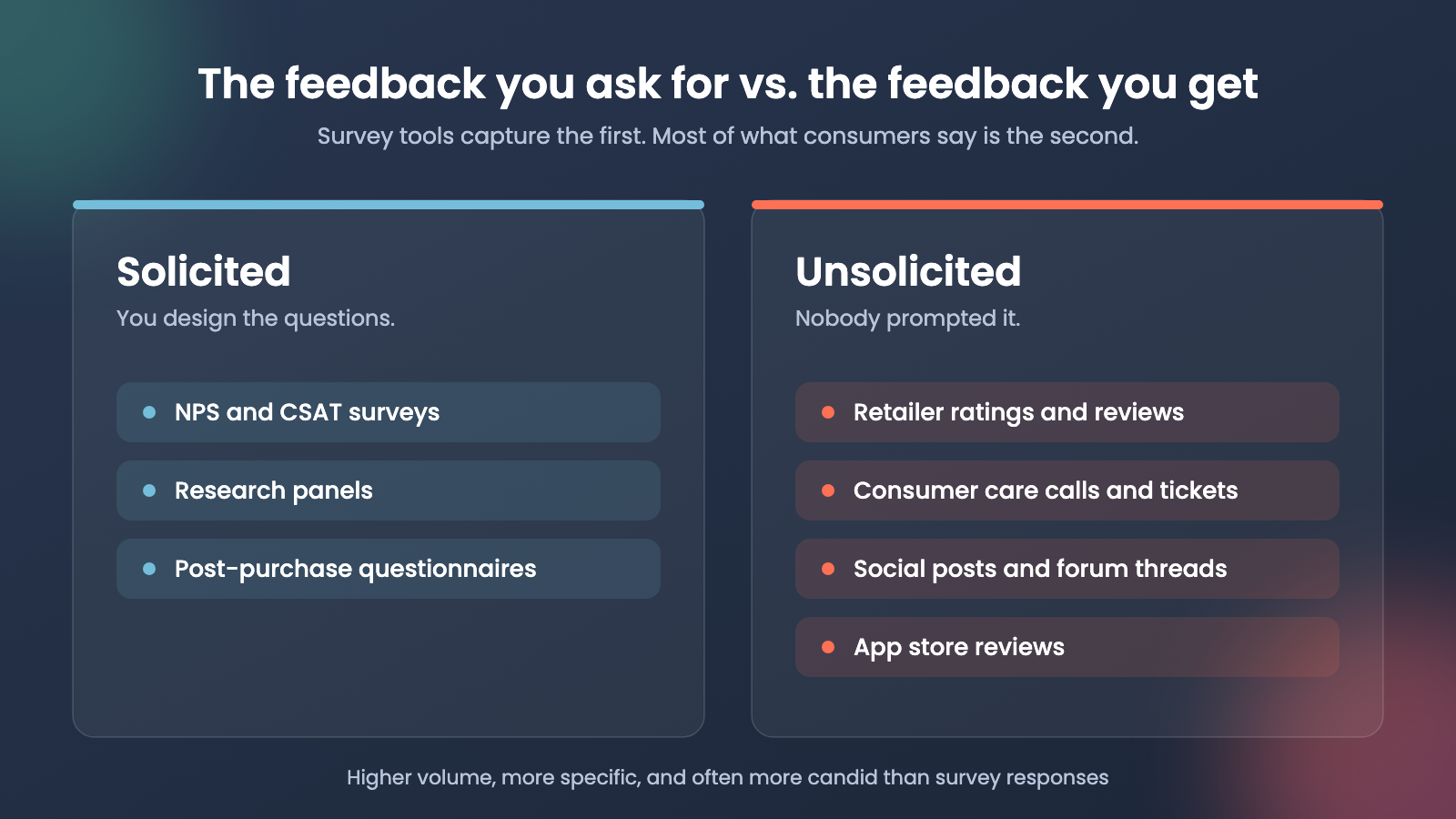
It’s also different from social listening tools that are strong at monitoring public social conversations, but only on that one channel. A true VoC platform includes social alongside reviews, support data, surveys, and more, then ties them together so you can see how what people post publicly compares to what they tell your support team.
The trap to watch for: a tool that calls itself a “VoC platform” but is really just one source with a dashboard on top. If a vendor can only show you survey results, social mentions, or reviews, that’s a single-source analytics tool, not a unified voice of customer platform.
The Fragmentation Problem: Why Most “Unified” VoC Isn’t
The VoC category is fragmented by source. The result is a market where almost everyone has a blind spot, and the word “unified” means different things depending on who’s saying it.

Here’s how the lanes break down:
Survey-led platforms like Qualtrics, Medallia, and InMoment built their businesses on solicited feedback. They’re excellent at NPS programs, CSAT surveys, and structured research you design and distribute. This lane is also consolidating: Qualtrics completed its acquisition of Press Ganey Forsta in May 2026, which brought InMoment under the same roof. These platforms have extended into unsolicited sources, such as Qualtrics analyzing calls, chats, social, and online reviews through XM Discover, and InMoment ingesting social reviews and call-center transcripts. But their center of gravity stays on solicited feedback. Where they tend to go less deep is SKU-level product reviews collected across retailers and competitive product signals from Amazon and Walmart.
Social and brand listening tools like Sprinklr are strong on social chatter and public brand mentions, and have moved into contact-center and broader CX. But SKU-level product review data isn’t where they go deepest. Knowing what people tweet about your brand is useful, but it’s a different kind of signal than knowing exactly which SKU has a packaging complaint that’s trending up on Target.
Support and ticket analytics platforms like Enterpret and Unwrap are built to make sense of call center transcripts, support tickets, and app store reviews. They’re especially popular with product and CX teams at software companies. But they ingest these sources through integrations rather than collecting retailer reviews at SKU scale, and they weren’t built with CPG category language in mind.
Review and social intelligence platforms like Wonderflow focused more on product review analytics. They’ve built proprietary crawlers that cover hundreds of review and social sources, and have expanded beyond those into surveys and customer care. Where they tend to differ is a multi-vertical approach built to span many product categories, and a survey tool that runs on a third-party panel rather than proprietary collection.
The solicited vs. unsolicited axis is the crux of it all. Survey tools capture the feedback you asked for. But the most honest, highest-volume signal your consumers generate, like the things they write in retailer reviews and say to your support agents, happens without anyone prompting it. And it’s the signal that survey-first programs are least built around.
So when a vendor tells you they’re “unified,” here’s the test: do they ingest retailer product reviews, consumer care and call center data, social media, AND surveys into one structured, queryable place? Or is “unified” really just one or two sources with some integrations bolted on? That question filters out a lot of noise very quickly.
What to Look for: The Evaluation Framework
If you’re comparing VoC platforms, here are the criteria that determine whether a platform is going to work for your team.
True source coverage and unification: This is the big one. Does the platform ingest reviews, consumer care, call center data, social, surveys, and mobile app reviews in a single platform? For consumer brands, retailer review coverage across Amazon, Walmart, Target, and hundreds of other retailers is the make-or-break. Consumer care and call center ingestion is one many platforms handle differently, so it’s worth confirming whether a given tool treats it as a core source or leaves it out. Which sources matter most depends on where your customers actually leave feedback.
Proactive vs. reactive intelligence: Does the platform surface issues you didn’t know to ask about through automated anomaly detection, trend alerts, and always-on monitoring? Or does it only answer questions you think to ask? A reactive tool puts more of the burden of knowing what to look for on your team, while a proactive one trades some of that control for automated surfacing. Which you want depends on how much your team can monitor manually.
Granular drill-down capability: Can you start at a broad category-level trend and drill down to a specific SKU in a specific retailer without switching tools or exporting data? The gap between showing brand-level sentiment and showing you which specific product at which retailer is driving that sentiment is the gap between interesting data and data you can act on.
Sentence-level theme and sentiment: Can the platform identify specific topics and sentiment at the individual sentence level within a review or call transcript? Or does it just slap an overall positive/negative score on the whole piece of text? The difference matters enormously. A review might be 80% positive but contain one sentence about a defect that affects your entire production run. A platform that scores that review as “mostly positive” will miss that.
Built-in agents and autonomous capability: Are there always-on AI agents that detect issues, track their progression over time, and benchmark your products against competitors? This is a real dividing line right now. Some platforms have moved past the “ask a question, get a summary” stage into 24/7 autonomous monitoring, while others stay closer to on-demand querying. The autonomous approach covers more ground but can give you less direct control over what gets flagged, depending on the platform.
Launch detection: If you’re at a large organization with dozens of brands and hundreds of SKUs, can the platform automatically detect when a new product launches across your portfolio? This sounds minor until you realize how often new products slip through the cracks at scale, especially when different brand teams manage their own launches independently.
Conversational access: Can someone on your brand team who isn’t a data analyst type a question in plain language and get an answer in seconds? Or do they need to navigate through modules, build custom queries, and know which filters to apply? The gap between those two experiences can make the difference in whether a tool actually gets used and widely adopted.
Access from the AI tools your team already uses: More teams now do their day-to-day work inside AI assistants like Claude and ChatGPT. Can the platform’s analysis be queried from those tools, for example through an MCP server, with the same permissions each user has in the platform itself? If it can’t, VoC data tends to get pulled manually or left out of the conversation entirely.
Category-native taxonomy and NLP: Does the platform understand your specific category language? “This melts fast” means something very different in chocolate versus candles versus cosmetics. A platform trained on generic, multi-vertical text data may misclassify a meaningful chunk of category-specific feedback, while one built for a specific category captures that nuance better but is less flexible across very different verticals. The right fit depends on how specialized your category language is.
Consistency and auditability: If two people on your team ask the same question, do they get the same answer? And can they trace that answer back to the actual source reviews and data points it came from? This is where structured databases and raw LLM prompts differ: a structured approach trades some flexibility for repeatability. A platform that stores analyzed data in a structured, sentence-level format will give you consistent, auditable answers every time. One that re-summarizes raw text on each query might give you something slightly different each time you ask.
Competitive product intelligence: Can it benchmark your products against competitor SKUs at the retailer level, automatically? Not just “how’s our brand doing vs. theirs” in the abstract, but “here’s how consumers talk about specific attributes of our vitamin C serum vs. their vitamin C serum on Amazon.”
Speed and time to value: Does it take weeks or months to get live and start pulling insights? Can your team start self-serving right away, or are you looking at a long implementation cycle with heavy service involvement?
Integrations and workflow: Does insight actually reach the teams that need to act on it? Can the platform tie feedback to sales data through integrations like Shopify? Can it push actions and tasks out to tools your broader team already uses, so insights don’t just sit in a dashboard nobody checks? Shareable charts, exportable reports, and connections to the tools people already use make a difference between insights that drive decisions and those that get buried.
Scale, security, and enterprise readiness: Does the tool support the multi-brand, multi-market, governance, security review, and volume handling requirements your enterprise needs to run at scale?
Red flags to watch for
- When a vendor says “unified,” ask them to show you each source type live, not just the one they lead with.
- Ask what’s included in the base price and what costs extra, so you can compare total cost rather than entry cost.
- If surveys are part of the pitch, ask whether the panel is proprietary or runs on a third-party provider, since that affects cost and data control.
- When you see an accuracy figure, ask to see it on a messy, real-world example from your own category rather than a polished demo case.
- Ask how long implementation actually takes and what your team needs to provide to get to first insight.
The Major VoC Platforms Compared
Here’s an honest look at the major players in the space, what each one does well, where the gaps are, and who each is best suited for. The chart gives the short version, and the details on each platform follow.
Yogi
Best for: Consumer brands unifying retailer reviews, consumer care, social, and surveys in one platform with category-trained NLP.
Key sources: Reviews from 400+ retailers, consumer care and call center data, social and forums, surveys, mobile app reviews, TikTok Shop, and Shopify sales data.
Strengths:
- NLP trained on category-specific language
- Natively unifies consumer care with reviews, social, and surveys
- Ask Yogi: conversational access for non-analysts
- Always-on issue and benchmarking agents for autonomous monitoring
- Sentence-level, structured, auditable analysis
- Auto-discovers topics and trends without predefined themes
- An MCP server that lets AI tools like Claude and ChatGPT query Yogi directly
- Enterprise-grade AI and security
Limitations:
- Not a survey-distribution tool (it integrates with Qualtrics, it doesn’t replace it)
- Not the fit if all you need is NPS program management
Qualtrics
Best for: Enterprise experience-management programs built around surveys and structured research.
Key sources: Surveys (NPS, CSAT, CES), plus calls, chats, social, and online reviews through XM Discover.
Strengths:
- Deep survey and research tooling at enterprise scale
- XM Discover analyzes unstructured feedback alongside survey data
- The broadest CX footprint in the category after acquiring Press Ganey Forsta (including InMoment) in May 2026
Limitations:
- Center of gravity is solicited feedback
- Not built around SKU-level retailer review collection and competitive product benchmarking
- Broad multi-industry focus rather than consumer-goods category language
Medallia
Best for: Large, compliance-heavy enterprise experience-management programs built on solicited feedback.
Key sources: Surveys and solicited or structured feedback, plus speech analytics for the contact center.
Strengths:
- Enterprise-grade compliance, security, and governance
- Complex multi-tier survey programs with deep executive reporting
- Role-based access and data controls for regulated industries
- Expanding speech and digital experience capabilities
Limitations:
- Survey-led and services-heavy, with longer implementations
- Text analytics centers on solicited and contact-center data rather than retailer reviews
- Not built for product- or SKU-level intelligence from unstructured feedback
InMoment (now part of Qualtrics)
Best for: Enterprise CX programs spanning surveys, conversational and call center intelligence, social reviews, and reputation management.
Key sources: Surveys (NPS, CSAT, CES), call center and chat transcripts, social reviews, and reputation management via ReviewTrackers.
Strengths:
- Broad CX coverage under one roof
- ReviewTrackers adds reputation management and review response for multi-location businesses
- Enterprise-scale, multi-channel survey infrastructure
- Call center and conversational analytics alongside surveys
Limitations:
- NLP rooted in CX and support, not product review analysis
- No SKU-level retailer product-review collection
- Broad multi-industry focus means less depth per vertical
- Implementation can be heavier than newer platforms
Sprinklr
Best for: Social-first brand and CX teams.
Key sources: Social channels, public brand mentions, and contact-center conversations.
Strengths:
- Strong on social chatter and public brand mentions
- Has expanded into contact center and broader CX
Limitations:
- SKU-level product review depth across retailers is not its focus
- Social signal is a different kind of data than verified-purchaser reviews and direct consumer care contacts
Chattermill
Best for: CX and VoC teams unifying surveys, reviews, social, tickets, and voice or call data; strong for international brands.
Key sources: Surveys, online reviews (via Trustpilot, app stores, and Qualtrics), social media, support tickets, and voice calls.
Strengths:
- Lyra AI with aspect-based sentiment (multiple themes per comment)
- Native connections across a wide range of sources
- Analysis in 100+ languages
Limitations:
- Reviews come in via integration, not proprietary retailer crawling
- Doesn’t auto-collect Amazon, Target, and Walmart reviews at SKU level
- Limited consumer-goods retailer and product-level depth
Enterpret
Best for: Product and CX teams at software companies unifying tickets, app-store reviews, social, surveys, and sales calls.
Key sources: Support tickets, app-store and public reviews, social, surveys, and sales calls, through 50+ integrations.
Strengths:
- Adaptive taxonomy learns product vocabulary automatically
- Maps feedback to CRM attributes (segment, renewal, revenue)
- Agents flag emerging issues automatically
- Plain-language querying
Limitations:
- Aggregates via integrations, not direct retailer crawling
- Built for software product and CX teams, not CPG retailer-shelf intelligence
- Not for SKU-level Amazon and Walmart review data at scale
Unwrap
Best for: Product, CX, and support teams wanting proactive insights with minimal setup; smaller teams without an analyst.
Key sources: Surveys, support tickets, calls, reviews, and app-store feedback, via integrations.
Strengths:
- Fast, low-configuration setup
- Surfaces trends automatically, without manual dashboards or tagging
Limitations:
- Integration-based ingestion, not proprietary retailer crawling at SKU scale
- Horizontal NLP, not consumer-goods-trained
- No retailer-level competitive product benchmarking
Build vs. Buy
At some point during the evaluation process, someone on your team (usually someone technical) is going to raise the question: Why don’t we just build this ourselves?
It’s a fair question. But the better question to ask is: What would it cost to build, operate, and maintain our own VoC tool over three years, and where do we want to be by then?
The stack you’d be signing up to build and maintain includes: product-retailer URL discovery, review collection infrastructure that has to adapt every time a retailer changes their site layout, product catalog entity resolution, an ingestion and normalization pipeline, dedupe and review-quality classification, sentence-level NLP, an analyst-grade UI, and a monitoring layer on top of it all. That’s not a weekend project. That’s a product.
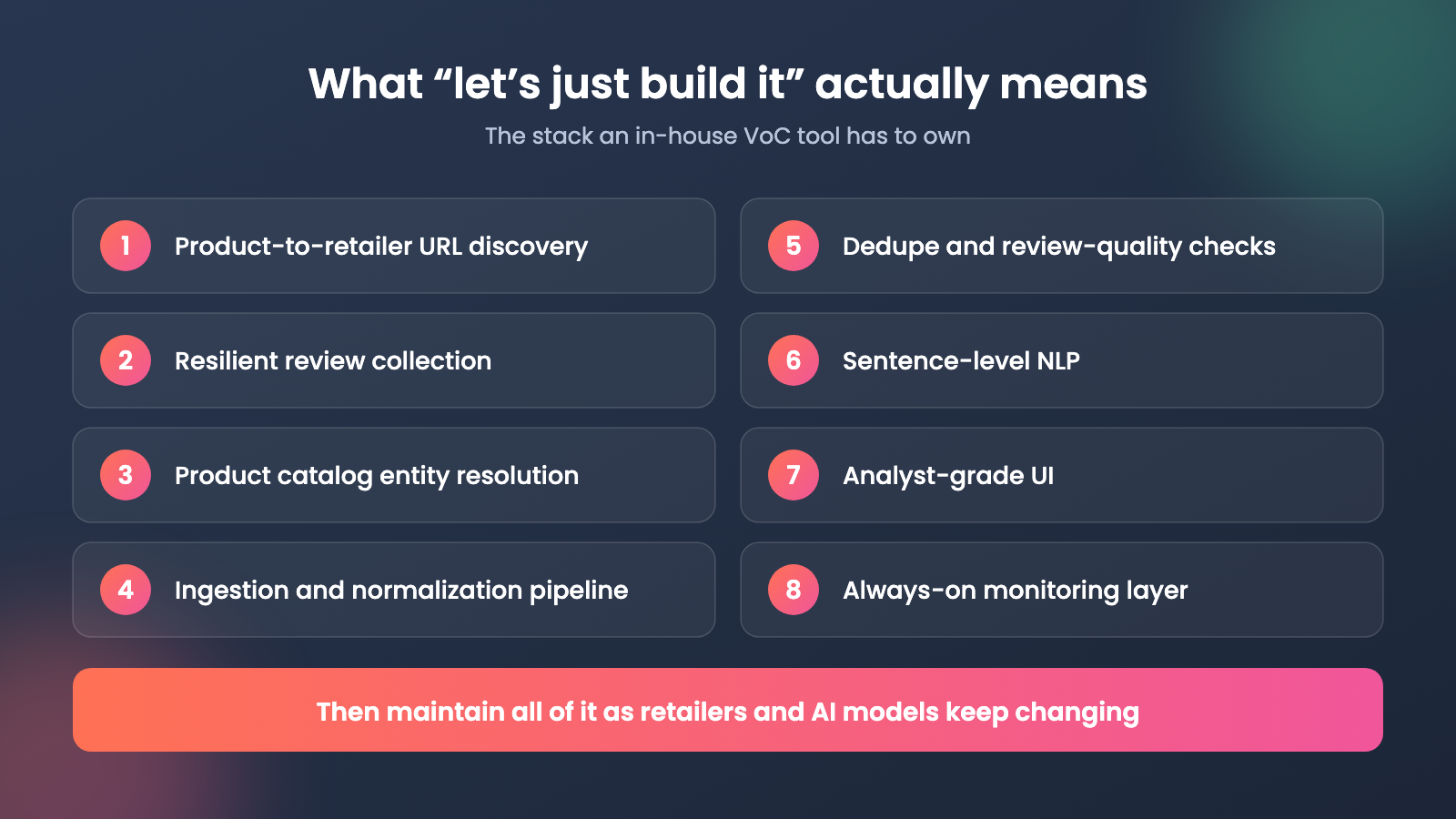
You can find a deeper dive into the build vs. buy discussion in our recent blog post, but here are eight quick considerations to think through when deciding to build a platform in-house:
- Product catalog intelligence takes years. Mapping products accurately across retailers, accounting for variants, duplicates, and naming inconsistencies, requires both AI and human validation over thousands of iterations. It’s not something you replicate in a sprint.
- Data quality errors are silent. Syndicated duplicate reviews and promotional reviews distort your conclusions before anyone notices. Without sophisticated dedup and quality classification, you’re making decisions on dirty data.
- Consistency requires structure. Every user should get the same answer to the same question. A structured, sentence-level database delivers that. An LLM re-summarizing raw text on each query might not.
- True build costs are almost always underestimated. Infrastructure, pipelines, security, compliance, model upgrades, and the opportunity cost of pulling senior engineering talent away from your core product are things very few organizations factor in before committing to build.
- Every internal tool needs an owner. Maintenance quietly falls on brand or insights teams who weren’t hired for data infrastructure work.
- AI model evolution is relentless. The state-of-the-art models from 12 months ago aren’t state-of-the-art anymore. Internal builds need re-architecting every six to 12 months to keep pace.
- Speed to value matters. 12 to 18 months to build a VoC tool vs. weeks to go live and start moving on insights can drastically impact your market position. Every day spent building is time spent not learning or adjusting to customer demands.
- Cross-client learning compounds. A platform refined across many enterprise clients in the same industry pulls ahead of a single-organization tool over time, because it learns from patterns across its entire customer base.
There’s also an AI maturity curve to consider. A general-purpose AI that summarizes feedback when asked is the most basic level. Purpose-built platforms operate further up that curve, running autonomously and surfacing issues before teams know to ask. The build question is really about which level you want to be at in three years, and what’s the fastest path there.
When building still makes sense: If you have a mature data science and ML organization, highly nuanced consumer intelligence needs, and consider this capability core IP you want to own, building can be the right call. But it’s worth noting that purpose-built platforms already exist that do everything listed above, and can be launched in a fraction of the time and money it takes to build on your own. If you’re still on the fence, below are a few questions to ask yourself to see if an internal build is right for you.
Decision checklist before you commit to an internal build
- Do you have dedicated data science capacity for this?
- Who owns maintenance after the initial build?
- What’s your time horizon to first insight?
- How many and how complex are your feedback sources?
- What’s the three-year total cost of ownership?
- What level of AI maturity are you targeting?
FAQ
What is a voice of customer platform?
A platform that captures consumer feedback from across channels (reviews, surveys, consumer care and support, and social media) and analyzes it to surface what consumers think and why. It goes beyond collecting feedback. It structures unstructured text, detects themes and sentiment, and routes insights to the teams that act on them. The distinction from a single-source tool, like a survey app or a review scraper, is that it consolidates all feedback into one queryable view.
What’s the difference between a VoC platform and a survey tool?
A survey tool collects solicited feedback: answers to questions you design and send, like NPS or CSAT. A VoC platform brings that survey data together with unsolicited consumer feedback, like reviews, social posts, and support tickets. That signal is typically higher-volume and more candid because nobody asked for it. Survey tools tell you how people answered your questions. VoC platforms tell you what people are saying, whether you asked or not. Most mature programs use both, but relying on surveys alone misses the majority of what consumers are telling you.
How do you tell if a “unified” VoC platform is actually unified?
A truly unified VoC platform should ingest reviews, consumer care and call center data, social, and surveys into a single, structured, queryable place. Here’s the fastest way to test it: ask whether a vendor pulls all of those sources natively, or whether “unified” is really just a dashboard sitting on top of one source type. Watch for platforms that call themselves VoC but are really just survey distribution with a reporting layer on top. A genuinely unified platform lets you compare what consumers say in reviews against what they tell your support team and what they post on social, all in one place.
What’s the best voice of customer platform?
It depends on where your feedback lives and who’s using the tool. Survey-led enterprise CX programs tend to lean toward Qualtrics or Medallia. Social-first teams gravitate toward Sprinklr. Support and product-feedback teams at software companies often choose Enterpret. For consumer brands whose customer voice lives primarily in retailer reviews and consumer care data, purpose-built consumer intelligence platforms like Yogi tend to be a better fit than general-purpose CX suites. The right move is to score each option against your actual feedback sources, the depth of AI analysis, and time to value, then demo on your own data.
What are the best alternatives to Qualtrics or Medallia for analyzing product reviews?
Qualtrics and Medallia are built around survey programs, so brands that mainly need product review intelligence usually look at review-native platforms instead. For consumer goods, that means tools that collect reviews across Amazon, Walmart, Target, and other retailers automatically and analyze them at the SKU level, such as Yogi. Many brands keep their survey platform for NPS and research and add a consumer intelligence platform alongside it for reviews, consumer care, and social. Yogi, for example, integrates with Qualtrics rather than replacing it.
What are the best tools to analyze customer reviews?
The strongest tools combine broad retailer coverage (Amazon, Walmart, Target, and beyond) with NLP trained on product-specific language. You want sentence-level theme and sentiment detection, not just star-rating aggregation. SKU- and variant-level granularity matters if you sell a lot of products; you need feedback tied to the specific item, not just the brand. General CX and survey platforms tend to go less deep on retailer reviews. Review-native and consumer intelligence tools go deeper.
How does VoC software compare to social listening?
Social listening covers one channel: public social media and forums. It’s strong for brand and PR monitoring. VoC software is broader. It includes social plus reviews, surveys, and support or consumer care, then ties them all together. Social listening tells you what people post publicly. VoC tells you what consumers experience across every touchpoint. They overlap, but social listening alone misses the highest-intent feedback: reviews from verified purchasers and direct support contacts from consumers who’ve actually used your product.
Which VoC platforms connect to AI assistants like ChatGPT and Claude?
A growing number of platforms expose their analysis to AI assistants through the Model Context Protocol (MCP) or similar connectors. Yogi offers an MCP server that lets any MCP-compatible tool, including Claude and ChatGPT, query Yogi directly: retrieving verbatims, filtering by product, sentiment, and theme, and tracking trends across reviews, social, and consumer care data. When you evaluate this, ask whether the assistant gets the platform’s structured analysis or just a dump of raw records, and whether each user’s permissions carry over.
Should we build or buy a VoC solution?
Most teams can build a basic version. The real question is the cost to operate and maintain it over multiple years. Building means owning review collection infrastructure, product catalog entity resolution, deduping, data quality classification, NLP models, UI, and re-architecting as AI evolves. Buying usually wins on speed (weeks vs. 12 to 18 months), a much lighter maintenance burden, and pre-built source coverage. Building makes sense for an organization with mature data and ML teams, where consumer intelligence is core IP you want to own. The hidden costs that many underestimate are ongoing maintenance ownership, silent data quality errors, and the opportunity cost of senior engineering talent.
What’s the best way to analyze Amazon and Walmart reviews at scale?
Use a platform that collects reviews automatically across retailers and refreshes continuously. Manual export doesn’t scale. Prioritize sentence-level theme and customer sentiment analysis so you see what drives ratings, not just the average score. Make sure reviews are deduplicated and that syndicated and promotional reviews are filtered, or your analysis will skew. Tie feedback to specific SKUs and variants, and benchmark against competitor products at the same retailer.
How accurate is AI sentiment analysis for product reviews?
Accuracy varies a lot based on how the model was trained. General-purpose sentiment models miss category-specific nuance. “The effects are long-lasting” is negative for a sleep aid but might be neutral or even positive in other contexts. Models trained specifically on product and retailer language perform meaningfully better than generic NLP. The most reliable systems classify at the sentence level and tie each result back to the source text, so outputs are auditable rather than a black-box score. When evaluating vendors, ask to see precision on realistic examples from your specific category, not cherry-picked demo data.
See a Real Unified VoC Platform in Action
If you’ve made it this far, you probably know you need a VoC platform, but the question is which one. The best way to know is to see a platform working on your own data, in your category, against your competitors.
If you’re looking for a platform that unifies retailer reviews, consumer care, social, and survey data in one place with category-trained AI and always-on autonomous agents, book a demo to see Yogi in action.
Unified Intelligence, Finally Within Reach
Ask Yogi cuts through silos and transforms scattered feedback into one continuous thread of truth—accessible to every team, whenever they need it.
It’s fast, defensible, and finally, actionable.
If you’ve ever wished for a way to get to the “why” behind your data without the delay—it’s here.
For a limited time, book a demo—and ask Yogi anything.


